
Agra Fort History
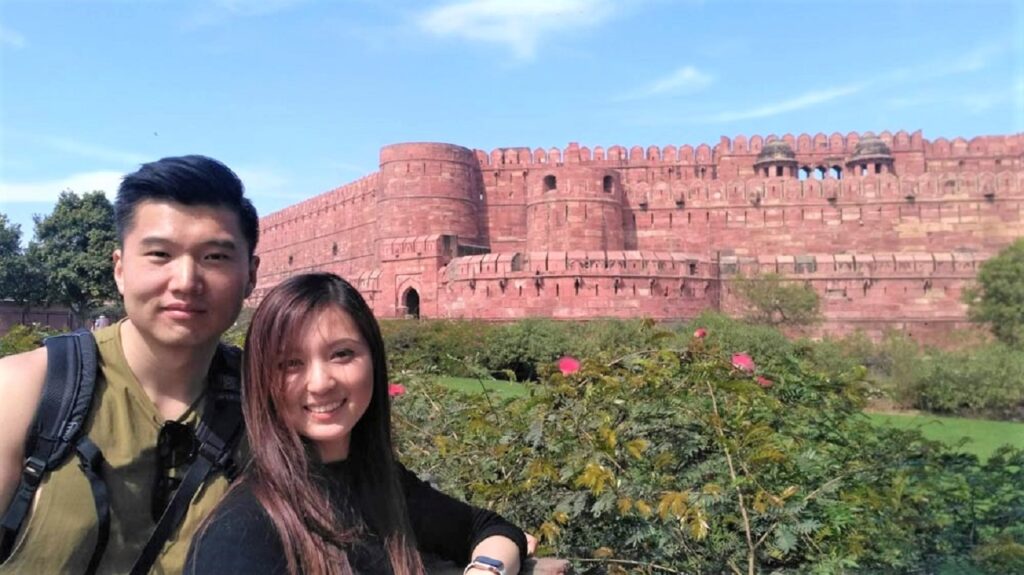
Agra Fort is a UNESCO World Heritage site located in Agra, India. The fort is also known as Lal Qila, Fort Rouge and Red Fort of Agra. It is about 2.5 km northwest of its much more famous sister monument, the Taj Mahal. The fort can be more accurately described as a walled palatial city.
Agra Fort built by Akbar in Red Sandstone when he was through with the consolidation of his power after accession to power, Agra Fort worked both as a military strategic point as well as the royal residence.Ever since Babur defeated and killed Ibrahim Lodi at Panipat in 1526, Agra played an important center of Mughal Empire it was in a ruined condition and Akbar decided to make it his capital and arrived in Agra in 1558 Akbar had it rebuilt with red sandstone. Architects laid the foundation and it was built with bricks in the inner core with sandstone on external surfaces. Some 1,444,000 builders worked on it for eight years, completing it in 1573.
Some of the exquisite structures that deserve a mention are:
Sheesh Mahal – Literally meaning ‘Glass Palace’ it was the royal dressing room adorned by tiny mirror-like glass-mosaic decorations on the walls.
The Diwan-i-Am – Which was used as a communications ground between the public and the aristocracy and once housed the Peacock Throne.
Diwan-i-Khas – A hall of private audience, it was used to welcome kings and dignitaries.
The Anguri Bagh – It houses 85 square, geometrically arranged lush gardens.
Khas Mahal – An immaculate white marble palace.
Mina Masjid – Literally meaning ‘Heavenly Mosque’ it is a tiny mosque closed to the public.
Nagina Masjid – Literally meaning ‘Gem Mosque’ it was designed exclusively for the ladies of the court.
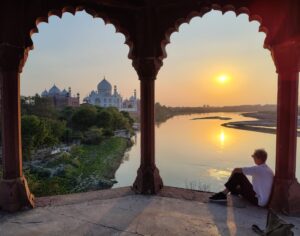
Musamman Burj – A large, octagonal tower with a balcony facing the Taj Mahal.
Architecture of Red Fort
The Agra Fort is laid out in the Karmuka style, the typical design of an emperor’s capital city. It is approximately rectangular on three sides, while the fourth side follows the curve of the Yamuna River. The Fort uses a double moat system, with one water moat (reputedly filled with crocodiles) and a dry moat (populated with man-eating tigers). It is further protected by two sets of red sandstone walls, the outer one 40′ high and the inner wall 70′ high. There are two functioning turrets or bastions, the Shah Burj and the Bengali Burj, along with 70 smaller towers. Access was gained via three primary gateways – the Delhi Gate (main entrance), the Amar Singh Gate (current visitor’s entrance), the Lahore Gate (facing Pakistan, the site of many famous political orations.
For more detailed information click here :- https://www.tajmahaltourguidefamilygroup.com/places-to-visit-in-agra/agra-red-fort